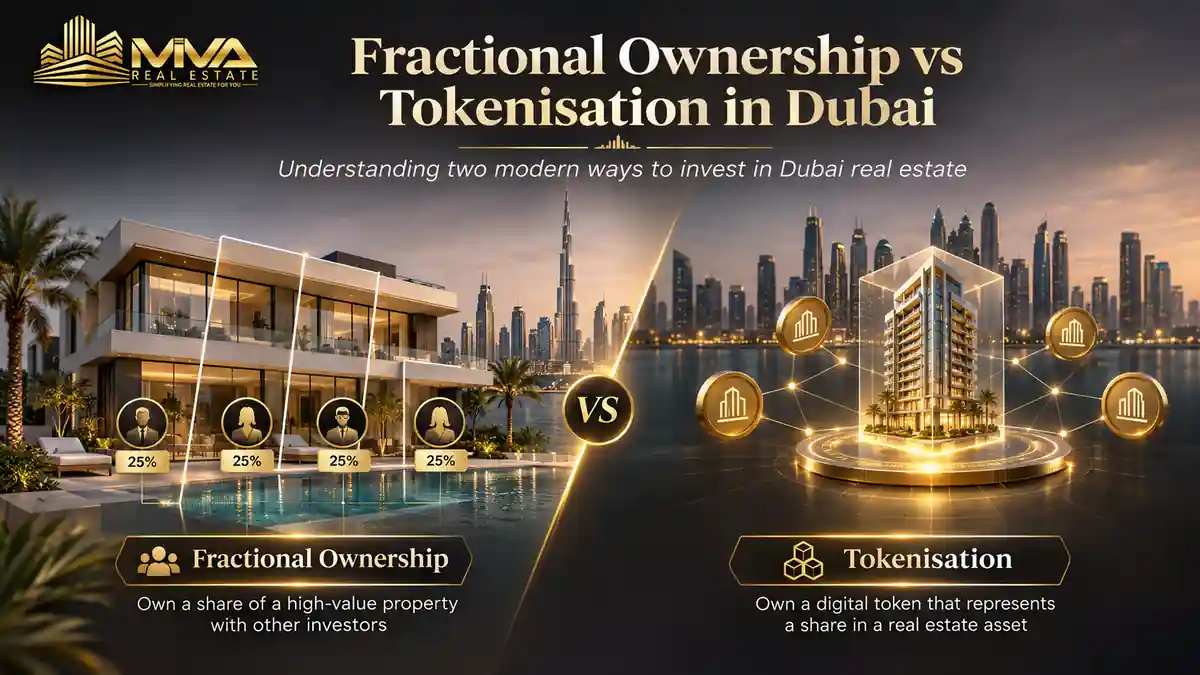
Fractional ownership means several investors share one property, usually through a company or co-ownership agreement. Tokenisation is a way of recording those shares as digital tokens. The two overlap, but legal structure, regulator, fees, eligibility and exit route differ by platform. Neither gives the same rights as a title deed to a whole unit.
1. Fractional ownership and tokenisation in plain terms
The two terms sit on different layers, not as rival products.
- Fractional ownership is the ownership model: more than one investor holds a share of the same property, through a special purpose vehicle (SPV, a company created to own it), a co-ownership agreement or, less often, shared names on the title deed.
- Tokenisation is the record-keeping and trading method: each share is a digital token on a blockchain, so it can be issued, tracked and, on some platforms, sold on a marketplace.
Most tokenised property is fractional property with a digital wrapper. What matters to an investor is what you legally own, who regulates it, what it costs and how you get out.
| Direct ownership (whole unit) | Fractional (SPV or agreement) | Tokenised (DLD pilot) | |
|---|---|---|---|
| What you hold | Title deed or Oqood record in your name | Shares in a company, or a co-ownership interest | Digital tokens linked to a share of one property |
| How it is recorded | DLD register | Company and platform records | Blockchain; DLD token ownership certificate reported at first offering |
| Who can invest | Eligible buyers in freehold areas | Platform-set; some accept international investors | Reported as UAE residents with Emirates ID at launch; check now |
| Minimum ticket | Price of the unit | Sources quote AED 500 to AED 5,000 and higher | Reported from AED 2,000; one source says AED 1,000 on resale |
| Exit | Sell the whole unit | Platform resale or property sale | Resale marketplace reported from Feb 2026; limited depth |
| Main regulator | DLD and RERA | Varies (DFSA for a DIFC platform, per its own statement) | DLD with VARA, Central Bank of the UAE and Dubai Future Foundation sandbox, per press |
Minimums, eligibility and regulators come from 2025 to 2026 press and platform sources and conflict in places. Read the table as a map of questions, not current terms.
2. How each model works in Dubai
Fractional through an SPV or agreement.
The platform buys a property, places it in an SPV and sells shares in that company. You own shares in the SPV, not the property, so your name is not on the title deed. Prypco Blocks says it uses a DIFC-registered SPV and is regulated by the Dubai Financial Services Authority (DFSA). That is the platform’s own statement; check the DFSA register.
Tokenised under the DLD pilot.
DLD launched the pilot phase of its Real Estate Tokenisation Project on 19 March 2025, aiming to let several investors co-own one property through tokenised assets, with VARA and Dubai Future Foundation as partners. Reported timeline:
| Date | Event | Source type |
|---|---|---|
| 20 Feb 2026 | Resale of tokens reported to open | Press |
| 9 Feb 2026 | Phase II announced | Press |
| May 2025 | First tokenised property offered; reported sold out within a day to 224 investors; DLD token ownership certificate reported | Press |
| 19 Mar 2025 | DLD pilot launched | Dubai Media Office |
Phase II terms are not confirmed on a DLD page, so resale detail is CONFIRM. DLD is also reported to project tokenised real estate at AED 60 billion by 2033, about 7% of Dubai transactions. That is a projection, not an outcome.
3. What it costs: look past the minimum ticket
A low entry price is the headline; the cost layers decide the result.
| Cost layer | What was reported | Source and date |
|---|---|---|
| Entry fee | 2% on investment | Khaleej Times, 10 Jun 2025 (Prypco Mint pilot) |
| Exit fee | 1% on selling tokens or the property | Same |
| Annual management | 0.5% a year | Same |
| Performance fee | Up to 15% of capital gain on sale | Same |
| DLD registration | 2% reported; another source says 4% DLD transfer fee applies on each fractional transfer | Khaleej Times; vendor guide. Sources conflict |
These are pilot-period figures and may have changed. Ask the platform for its current fee schedule in writing.
- Fixed costs hurt small tickets. Cushman & Wakefield Core notes that platform, blockchain, legal and compliance costs can push total entry cost above a conventional purchase.
- Property costs still apply. Service charges, maintenance and vacancy reduce what reaches investors. See Miva’s guides to buying property in Dubai and property investment.
- Projected returns are marketing until proven. Returns depend on rent, occupancy, fees and the sale price. None is guaranteed.
4. Liquidity and exit: tradable is not the same as easy to sell
- Knight Frank (16 Dec 2025) argues secondary trading can offer faster exits and widens the investor funnel rather than replacing traditional ownership. That is a consultancy’s view, not a measured outcome.
- Cushman & Wakefield Core notes secondary markets are often thin and tokens can trade at a discount, or at a premium unrelated to the property’s fundamentals.
- A sale needs a buyer. If few want your tokens, the price may fall below what you paid.
- Some structures allow a vote to sell the whole property. Check who votes, the threshold and the timing.
Before investing, ask who sets the resale price, what the lock-in or notice period is, and what happens if the platform stops trading.
5. Who can invest
Early reports describe the DLD-backed Prypco Mint pilot as open to UAE residents aged 18 or over with an Emirates ID, with international access planned for later phases. We found no confirmed opening to non-residents. A third-party review says Prypco Blocks, a separate fractional product, accepts international investors; confirm with the platform.
If you live outside the UAE, ask whether the platform accepts your country, what KYC and source-of-funds checks apply, and whether income and sale proceeds can reach your home bank.
6. Golden Visa, mortgage and tax: do not assume
- Golden Visa: the property-investor route is built around registered property worth at least AED 2 million, and a joint owner’s own share must meet it. We found no official statement that a fractional or tokenised interest counts, and one third-party source says an SPV interest does not meet the name-on-deed requirement. Do not buy a token or share for visa reasons. See Miva’s Golden Visa service page and ask a qualified residency adviser.
- Mortgage: a share in an SPV or a token is not a mortgageable title. Ask a mortgage professional; see Miva’s mortgage service.
- Tax: buyers must check tax obligations in their home country, and some jurisdictions may treat a tokenised or fractional interest as a fund or security. Dubai property is not universally tax-free. Ask a qualified tax adviser.
7. Risks to weigh
| Risk | What it means |
|---|---|
| Liquidity | You may not be able to sell when you want, or at the price you expect |
| Platform | You depend on the operator for custody, valuation, maintenance and payouts |
| Regulatory change | DLD’s programme is described as a pilot; VARA and DLD rules may change, and sources conflict on dates |
| Valuation | Token prices follow the property, which can fall as well as rise |
| Concentration | One token usually means one property |
| Governance | Majority votes can decide repairs, rent levels or a sale |
| Technology and cyber | Wallets, platforms and blockchains can fail or be attacked; see Miva’s crypto property article |
| Fraud | Deal only with VARA-licensed or DFSA-regulated operators you have verified; see Miva’s RERA warning |
8. Miva’s view: pros, cons and who it suits
| Pros | Cons | Who it suits | |
|---|---|---|---|
| Fractional (SPV or agreement) | Lower ticket than a whole unit; professional management; shared costs | You own shares, not the deed; exit depends on the platform; fees reduce income | Investors who accept an indirect, longer-term holding and have read the offering documents |
| Tokenised (DLD pilot) | Very low entry price; DLD-linked certificate reported; digital records; possible resale market | Pilot status; eligibility may be limited; thin resale market; rules and fees may change | UAE-resident investors testing the market with money they can leave invested |
| Direct ownership | Registered title; more control; clearer route to mortgage, leasing and residency rules | Higher entry cost; one asset; slower to sell | Buyers who want control and can fund a whole unit, ready or off-plan |
Miva does not operate, endorse or earn from a tokenisation or fractional platform, and does not recommend one here. We help compare these routes against a whole-unit purchase for your goal, budget and residency status. If your budget points to a whole unit, read apartments in Dubai under AED 1 million and the ready vs off-plan guide.
9. Checklist before you invest
- Confirm the operator’s licence on the VARA or DFSA register and the property record with DLD
- Read the offering document: what you own, who holds title, who decides on a sale
- Get the full fee schedule in writing: entry, annual, exit and performance fees
- Ask how and when you can sell, and what resale prices have been on that platform
- Check you are eligible and that your country allows the investment
- Ask for the assumptions behind any projected return
- Take legal and tax advice for your residency
- Decide how much you can leave invested without needing it back
10. Talk to us before you decide
If you are comparing a small-ticket platform with a whole-unit purchase, we can walk through both against your goal, budget and residency status, then send a written shortlist. Book a free consultation or chat on WhatsApp. Buying from abroad? See the country guides and the Miva team.
Frequently Asked Questions
Is tokenised property the same as fractional ownership?
Not exactly. Fractional ownership is the model of sharing a property; tokenisation is a digital way of recording and trading those shares. Most tokenised property is fractional underneath.
Can foreigners invest in tokenised property in Dubai?
Early reports say the DLD-backed pilot was open to UAE residents with an Emirates ID. We found no confirmed opening to non-residents, so check the platform and DLD.
Do I get a title deed if I buy a token?
Press reports say DLD issued a Property Token Ownership Certificate for the first tokenised property. That certifies the token holding; it is not a title deed in your sole name. Read how the offering records ownership.
Is tokenised real estate safe?
It carries normal property risks plus platform, liquidity and regulatory risks, and is still described as a pilot. Use only operators you have verified.
Does fractional or tokenised property qualify for the Golden Visa?
We found no official confirmation that it does. The route is built around registered property worth at least AED 2 million. Ask a qualified residency adviser and do not buy for visa reasons alone.
Which is better: fractional, tokenised or a whole unit?
It depends on goal, budget, residency status and how long you can stay invested. None is better in every case and none guarantees a return.