1. Who does what in a Dubai purchase
People ask “do I need a lawyer?” because several parties seem to be doing legal-looking work. Most of them are doing something narrower.
| Role | What they do | What they do not do |
|---|---|---|
| Agent (RERA-registered broker) | Finds the property, negotiates and prepares the standard agreement on a resale | Advise you on your legal position |
| Registration trustee centre | A DLD-licensed office where buyer and seller, or their representatives, submit documents and pay fees; a registrar enters the transaction | Review the deal for you |
| Dubai Land Department | Registers the sale and issues the title deed, or records an off-plan sale in the interim register | Check that the price is fair |
| Developer | Issues the no-objection certificate (NOC) on a resale and registers off-plan sales through its Oqood portal | Act for the buyer |
| Bank | Values the property and lends against it; its own checks protect the bank’s security | Advise you on your contract |
| Lawyer | Advises you on your legal position: contract terms, powers of attorney, structure | Value the property or remove market risk |

In practice, the lawyer is the only role whose sole job is to advise you. That does not make one necessary on every deal. It tells you what you are buying when you hire one.
2. How much a lawyer adds, by deal type
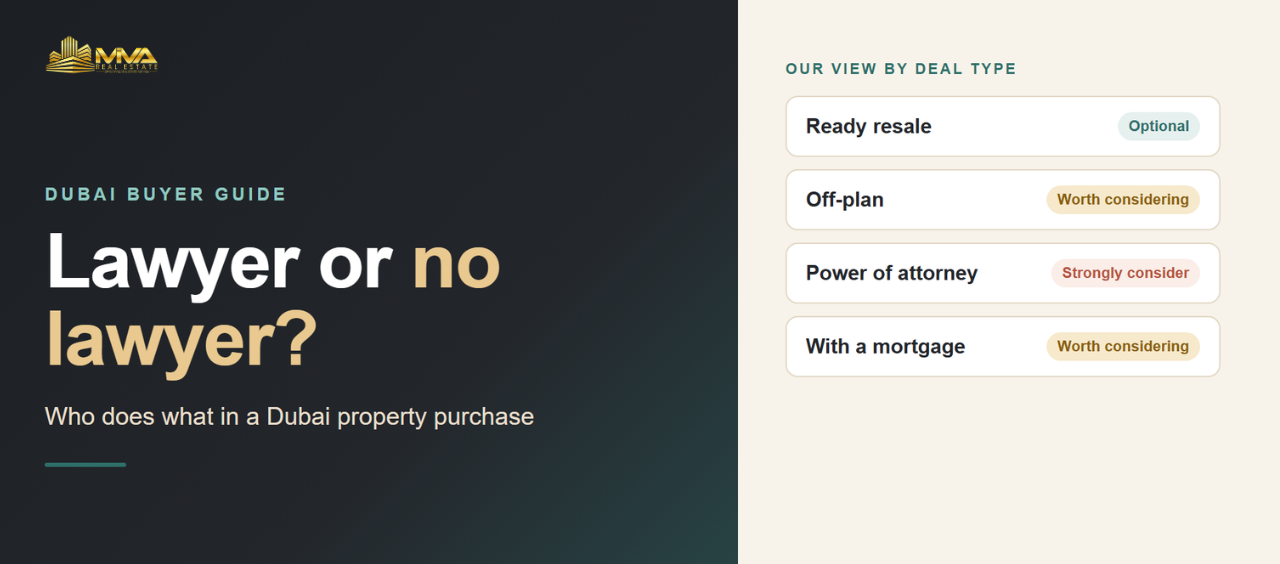
| Deal type | What makes it different | Lawyer: Miva’s view |
|---|---|---|
| Ready resale, no mortgage | Standard agreement and a set trustee-centre process | Optional |
| Off-plan from a developer | A developer contract, a payment schedule, delay and cancellation terms | Worth considering |
| Buying through a power of attorney | Exact wording, attestation and translation must be right | Strongly consider |
| Mortgage-financed purchase | Bank conditions, release letters and extra registration | Worth considering |
| Company or joint ownership | The company must be registered first; shared rights need setting out | Strongly consider |

3. A ready resale: what the process looks like without a lawyer
DLD’s property sale registration page describes the path. The seller and buyer, or their legally authorised representatives, attend a registration trustee centre. Each brings an Emirates ID, or a passport for non-resident foreigners. In freehold areas the developer’s e-NOC, obtained through the Dubai REST app, is also needed. The registrar enters the transaction, the fees are paid, and DLD lists about 20 minutes for the service-centre step.

Before that, the buyer and seller sign the standard Form F agreement. Sources commonly describe a deposit of about 10% of the price, but they disagree on who holds it, so read the form you are given and ask your agent in writing. We did not find the Form F text on a DLD page.
What the DLD page lists as fees (accessed 19 November 2026):
| Item | Amount |
|---|---|
| Registration fee | 4% of the sale value: DLD shows 2% for the seller and 2% for the buyer. Who actually pays is a matter for the contract |
| Service partner (trustee) fee | AED 4,000 plus VAT at AED 500,000 or more; AED 2,000 plus VAT below that |
| Title deed certificate | AED 250 |
| Maps and small fees | AED 100 to AED 250 depending on the property, plus AED 10 knowledge and AED 10 innovation fees |
Fee amounts change. Check them on the DLD page, or with your trustee centre, on the day you pay.
Where a lawyer can still help on a resale: reading the Form F before you sign, checking the seller’s authority to sell, and confirming what happens to your deposit if the deal fails. If the price is modest, the unit is vacant, the seller is the registered owner and you are comfortable with these points, many buyers go ahead with their agent and the trustee centre.
4. Off-plan: the contract is the main reason to pay for advice
An off-plan purchase is a contract with a developer for something not yet built. Dubai’s Law No. 13 of 2008 requires an off-plan disposition to be entered in the Interim Property Register, and says a sale not entered there is void (Article 3(1)). Article 10 treats a private off-plan sale contract in a project not approved by the competent entities as void. DLD’s own page for the initial sale confirms that the developer registers the sale through its Oqood portal, and that the contract is signed by both developer and purchaser.
Registration answers whether the sale is recorded. It does not answer what the contract says. A lawyer’s value here is in the clauses: payment schedule, what happens if the handover is late, cancellation and assignment terms, and how the developer may change the plans. One law firm recommends a lawyer for off-plan purchases above AED 1 million. That is a firm’s recommendation, not a legal requirement.
Whether you hire one or not, verify the project and developer yourself through the DLD and RERA records. Our guide to verifying a Dubai off-plan project shows how. Registration and escrow do not remove construction, delay or market risk.
5. Buying through a power of attorney
Many overseas buyers cannot attend a trustee centre. DLD allows a representative with a legal power of attorney (POA) to act for a party. This is where small errors cost the most time.
Law-firm commentary says DLD Circular 29/R/2025, dated 16 July 2025, tightened how POAs are accepted: the document should authorise the specific transaction, name the property, and be electronically verified. We could not retrieve the circular text, so treat this as secondary.

Sources disagree on details, which is itself a reason to take advice:
- Validity. One source gives two years for a sale and five for a purchase POA. Another says a notarised POA stays valid unless it states an expiry. Confirm the period for your document.
- Attestation chain. A POA signed abroad may need notarisation, legalisation or apostille, UAE attestation and an Arabic translation. One source treats an apostille alone as insufficient. Ask a Dubai notary or lawyer to confirm the current chain before you sign anything.
- Names and details. A mismatch, even a transliteration difference, can stop the transaction.
We recommend legal advice here. Let the lawyer draft or approve the POA, and name only a person you trust.
6. A mortgage changes the paperwork
If you are buying with a mortgage, the bank values the property and lends against it. Its legal checks protect the bank’s security. They are not advice to you.
If you are buying a mortgaged property, DLD’s process requires extra documents: a liability letter from the bank or developer, a mortgage release letter, and three manager’s cheques (to the bank or developer, to the seller for any balance, and to DLD for the 4% fee). If you take a new mortgage, DLD lists a registration fee of 0.25% of the mortgage value plus smaller fees. Registrar fees are waived where the mortgage is registered on the same day, and otherwise a service partner fee of AED 4,000 plus VAT applies.
None of this needs a lawyer by law. The risk is sequencing: cheques, release letters and registration must line up on one day. Your agent and trustee centre will usually manage this. A lawyer is worth considering if the seller’s mortgage balance is high, the seller’s bank is slow, or your loan terms are unusual. For the loan itself, see our guide to using a Dubai mortgage calculator.
7. What a lawyer can and cannot do

A lawyer is not a substitute for knowing what you are buying. They will not tell you whether the price is fair, whether the community suits your family or whether the rent will cover your costs. That is the comparison work an adviser does.
Cost. Lawyer fees are not regulated, so there is no standard figure. Ask for a written scope and fee before you instruct anyone, and ask what is and is not included, such as attending the trustee centre. We have not quoted ranges because the figures we found came from commercial blogs.
8. Questions to ask before you hire one
- Are you licensed to practise in Dubai, and have you handled a purchase like mine?
- What exactly will you review: the Form F or developer contract, the POA, the title and any mortgage?
- Will you attend the trustee centre, or only advise beforehand?
- What is the fixed fee, and what would add to it?
- Who will do the work, and how fast can they respond?
9. Miva’s Real Estate view: pros, cons and who it suits
Pros of hiring a lawyer
Independent advice on the contract and your legal position. Helps most with off-plan terms, POAs and company or joint ownership. Gives a second pair of eyes on documents you cannot easily read yourself.
Cons
An extra cost with no regulated fee. Can add time. Does not reduce market, price or delay risk, and quality varies, so choose with care.
Who it suits
Off-plan and POA buyers, overseas buyers who cannot attend, anyone buying through a company or with co-owners, and buyers of high-value or unusual properties. A straightforward resale buyer comfortable with the documents may reasonably go without.
10. Your checklist before you decide
- I know whether my deal is a resale, off-plan, POA, mortgage-financed or company purchase.
- I have read the Form F or developer contract in full, or someone qualified has.
- I have checked the agent’s registration and the developer and project records.
- If I am using a POA, a Dubai notary or lawyer has confirmed the wording and attestation chain.
- I know who pays the 4% registration fee under my contract, and I have budgeted the trustee fee.
- I have a written scope and fee from any lawyer I instruct.
- I know what happens to my deposit if the deal fails.
Need help comparing your options?
We compare a small number of Dubai properties against your goal and budget, then coordinate the purchase steps with the professionals you choose. Miva is not a law firm and does not give legal advice.
Frequently asked questions
Do you need a lawyer to buy property in Dubai?
What does a trustee office do in Dubai?
Who pays the DLD fee, the buyer or the seller?
Do I need a lawyer to buy off-plan in Dubai?
Can I buy Dubai property without being in Dubai?
How much does a property lawyer cost in Dubai?